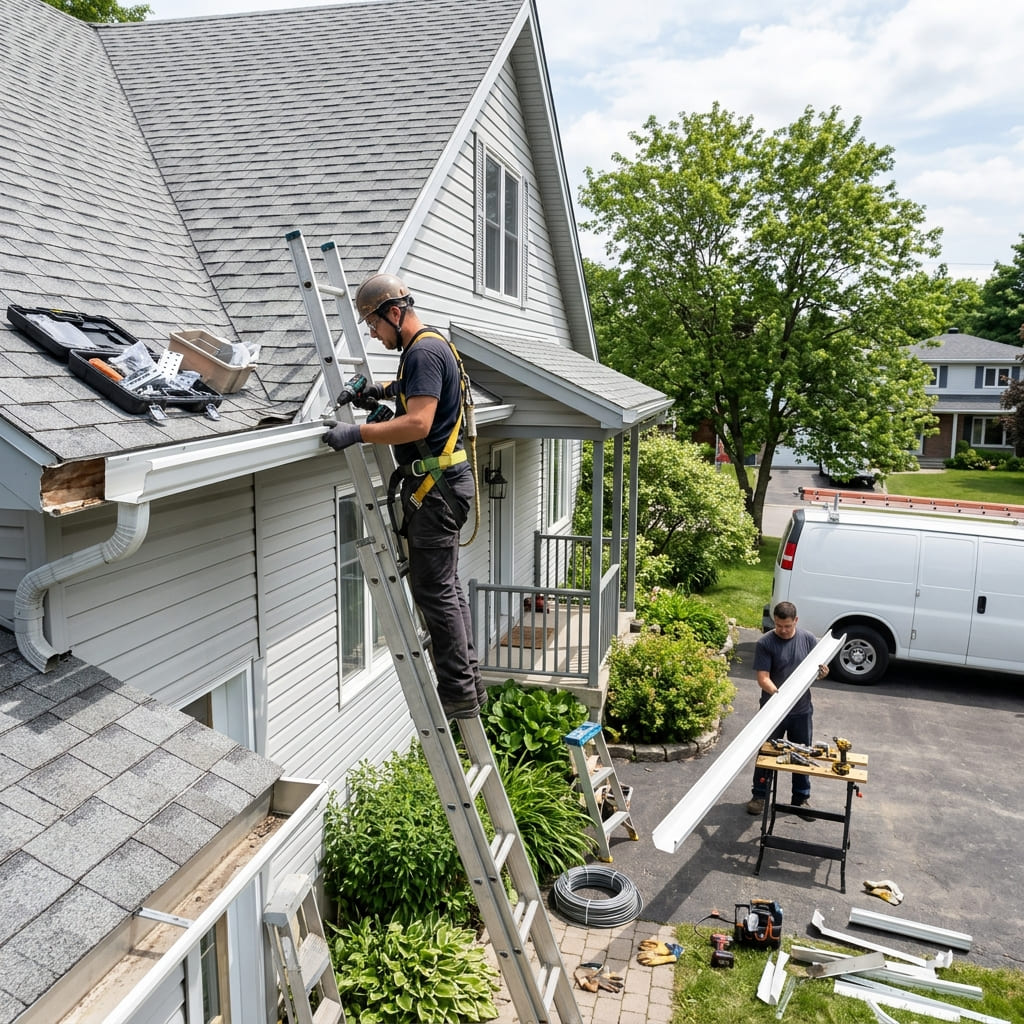
When a Grand Rapids home needs new gutters installed
Installation means putting gutter where there is none, or redesigning the system rather than swapping like for like. That is different from replacement, and it comes up in Grand Rapids for a few common reasons.
- A rear elevation, porch or addition that never had gutter, leaving water to pour onto steps and the foundation.
- A detached garage dumping roof water onto the drive, where it freezes into a sheet of ice all winter.
- After a re-roof, when new drip edge and shingle overhang change how water and snow leave the roof.
- Upgrading for snow load — heavier gauge, tighter hangers and larger trough after a winter that bent the old system.
- Hillside drainage problems, where water needs to be collected and carried past the downhill side of the house.
If gutter is already hanging and the plan is to take it down and put similar back up, read the Grand Rapids gutter replacement page instead.
Spec for snow: gauge, hangers and fascia
Most gutter specs are written for rain. In Grand Rapids, the system also has to hold weight for months. Three things decide whether it does.
Gauge
Standard aluminum gutter is .027 inch thick. Heavier .032 aluminum resists bending under packed snow and the impact of sliding snow far better, for a modest increase in cost. On a Grand Rapids home it is one of the best-value upgrades available.
Hangers
Use hidden hangers fastened with screws, not spikes and ferrules. Spacing matters as much as type. A typical 24-inch spacing is a rain spec; 16 to 18 inches suits Grand Rapids snow loads better, and tighter still under steep planes that shed heavy snow onto the gutter.
Fascia
A hanger is only as strong as the wood it screws into. Soft or rotted fascia needs to be replaced before any new gutter goes up. On older homes, hangers can be fastened through the fascia into the rafter tails for extra hold.
| Spec | Typical rain-climate install | Grand Rapids snow-load install |
|---|---|---|
| Aluminum gauge | .027 inch | .032 inch |
| Hanger type | Hidden hanger or spike | Hidden hanger with screws only |
| Hanger spacing | 24 inches | 16 – 18 inches, tighter under steep planes |
| Trough size on steep roofs | 5-inch | 6-inch with 3x4 downspouts |
| Fascia | Assumed sound | Probed and replaced where soft |
Sizing: 5-inch or 6-inch?
Sizing depends on roof area, roof pitch, and how hard water arrives. In Grand Rapids, the hardest test is not a summer storm — it is a warm spell in March or April that melts a deep snowpack while rain falls on top of it.
Five-inch K-style with 2x3 downspouts is adequate on many ranches and smaller bungalows. Six-inch with 3x4 downspouts holds about 40 percent more water and moves roughly twice as much through each downspout. It makes sense on steep Victorian and Tudor roofs, long runs, valleys that dump into one short section, and homes under heavy oak and maple.
The practical Grand Rapids rule: if the old gutter has ever been bent by snow or overflowed during a melt, step up to 6-inch and heavier gauge. On a low-slope ranch in Kentwood with a small roof and few trees, 5-inch is fine.
Materials that make sense in Grand Rapids
Seamless aluminum
Roll-formed on site into one continuous run, with joints only at corners and end caps. It does not rust, comes in a wide colour range, and is the best value by a distance. Choose the heavier gauge.
Galvanized and galvalume steel
Stronger than aluminum and better at taking a snow load or a ladder without bending. It is sectional, heavier on the fascia, and will eventually corrode at cut edges.
Copper and half-round
The traditional choice on Heritage Hill's Queen Anne, Italianate and Prairie-style homes. Copper is soldered rather than sealed and can last for decades, but costs several times what aluminum does — commonly $30 to $55 per foot and up. On a home in a local historic district, it may be what the Historic Preservation Commission expects where copper was original.
How a gutter installation goes
- Measure and assess. Every run measured, roof planes and valleys noted, fascia probed, and downspout locations chosen with the slope of the lot.
- Fascia and drip edge prepared. Soft board replaced. A gutter apron or drip edge fitted so water and meltwater go into the trough, not behind it.
- Gutter roll-formed on site to the exact length of each run, in the chosen gauge.
- Hung on hidden hangers with screws at snow-load spacing.
- Pitched to the outlets — about a quarter inch of fall per ten feet — so water does not stand and freeze.
- Downspouts hung and strapped, with extensions carrying water away from the house and downhill.
- Water tested along every run, then clean-up and haul-away.
Most single-family installs are a one-day job. Fascia replacement, tall homes and historic district approval add time.
Gutter installation cost in Grand Rapids
Typical Grand Rapids ranges, not quotes. Footage sets the base; height, gauge, fascia and material set the rest.
| Line item | Typical Grand Rapids range | Notes |
|---|---|---|
| 5" seamless aluminum, installed | $8 – $14 / ft | Gauge, colour and corner count move this |
| 6" seamless aluminum, installed | $11 – $18 / ft | Includes 3x4 downspouts and heavier hangers |
| Upgrade to .032 gauge | Add roughly $1 – $2 / ft | Strongly worth it for snow load |
| Galvanized or galvalume steel | $14 – $22 / ft | Sectional; stronger and heavier |
| Copper half-round | $30 – $55+ / ft | Historic district work; material prices swing |
| Downspout, per drop | $70 – $180 | Height, elbows and straps |
| Extended or buried discharge | $150 – $600+ per run | Depends on slope and distance |
| Fascia replacement | $10 – $25 / ft | Common on older homes |
| Gutter apron / drip edge | $2 – $5 / ft | Cheap and high value |
Worked example. A Grand Rapids bungalow with 140 feet of run, four downspouts and 5-inch .032 aluminum, no fascia work: roughly $1,500 to $2,400. The same house in 6-inch with 3x4 downspouts: roughly $2,000 to $3,000.
Where the water goes on a Grand Rapids lot
A gutter only collects water. The point is getting it past the foundation, and on a sloped lot that takes planning.
Grand Rapids separated its old combined sewers over more than twenty years, finishing
the long-term control plan in 2015. Roof water belongs on the lawn or in a properly
designed drain, not in the sanitary line.
On hillside streets in Heritage Hill and Belknap Lookout, put downspouts where the
grade falls away and use extensions to carry water six to ten feet out, downhill and
away from the house and the neighbours.
Historic districts
Exterior changes to homes in Grand Rapids' local historic districts are reviewed by the Historic Preservation Commission. Heritage Hill, with around 1,300 homes dating back to 1844, is the largest. Cherry Hill and others are covered too.
Replacing copper half-round with new copper half-round is a very different application from switching to aluminum K-style. Build the review into your timeline and ask any contractor whether they have worked through the commission before.
Neighbourhoods we cover in Grand Rapids
Installation calls come from across the city — copper and half-round work on Heritage Hill and Cherry Hill, snow-load upgrades on the steep Tudors of Ottawa Hills and East Hills, garage and rear-elevation runs in Alger Heights, Garfield Park and Creston, and new systems on the West Side around John Ball Park.
Coverage also runs into East Grand Rapids, Kentwood, Wyoming, Walker and Ada. Call 123-456-7890 with a cross street to confirm.
Get a gutter installation estimate in Grand Rapids
Call GutterSquad Michigan at 123-456-7890. Have the neighbourhood, the number of storeys, roughly how much gutter the house needs, and any snow damage from last winter. That is enough for a Grand Rapids gutter professional to give you a realistic range and book a site visit.
Not sure whether you need a new system or a fix? The Grand Rapids gutter repair page covers what is worth saving, and the Grand Rapids services hub lays out all four jobs side by side.