
What makes Detroit gutters different
Most gutter advice on the internet is written for a house built after 1990 with two-foot overhangs, solid pine fascia, and a downspout that ends in a splash block. Detroit is not that house.
The city's residential stock is dominated by homes built between roughly 1910 and
1955 — brick bungalows with front dormers, two-family flats, Tudors, four-squares
and colonials. They tend to have steep roof pitches, short eave
overhangs, and original wood fascia that has been painted a dozen times
and, in a lot of cases, is soft behind the paint.
That combination changes almost every decision on a gutter job. A steep pitch
throws water further and faster, so a 5-inch trough that would be fine on a
low-slope ranch overshoots. A short overhang means there is less room for error
in the hanger placement. And soft fascia means the fastener has nothing to bite,
which is why so much Detroit gutter is quietly hanging on by three screws out of
twelve.
Four Detroit-specific problems worth knowing about
1. Built-in box gutters. On homes built before about 1920 — common through Woodbridge, Corktown, Brush Park and the older North End streets — the gutter is framed into the cornice rather than hung off it, then lined with metal or membrane. When that liner fails, the water goes into the wall instead of down the outside of the house. A box gutter leak is a framing problem on a clock.
2. Buried downspout leads. Detroit operates a largely combined sewer system, and on much of the pre-war stock the downspout drops into a buried line at the base of the wall that ties straight into it. Those leads are eighty to a hundred years old. When one collapses, water surfaces right at the foundation. DWSD encourages disconnecting downspouts and running roof water onto the lawn instead — which, on most Detroit lots, is both cheaper and better for the basement.
3. Maple seed, not just leaves. Detroit's street canopy leans heavily on silver and Norway maple, with a lot of tree-of-heaven filling in on vacant land. Late May brings a samara drop that packs into a dense, wet mat — it is not leaf litter, it is a plug. Anyone who has had a gutter overflow in June on a sunny week has met it.
4. The historic district layer. Detroit has a large number of locally designated historic districts, and exterior changes visible from the public right-of-way generally require review by the Detroit Historic District Commission. Repairing in kind is usually straightforward. Replacing a copper half-round with white aluminum K-style is a different conversation entirely. If the house is in Indian Village, Boston-Edison, Palmer Woods, West Village or Sherwood Forest, factor that into the timeline.
The single most useful thing a Detroit homeowner can check: put a screwdriver into the fascia board behind the gutter, near a downspout outlet. If it sinks in, no new gutter is going to hold on it, and any quote that does not mention fascia is not a real quote.
The four gutter services in Detroit
Almost every Detroit gutter call resolves into one of four jobs. Working out which one you actually need before you get a quote is worth real money — a $180 cleaning solves a surprising number of problems that look like a $2,500 replacement.
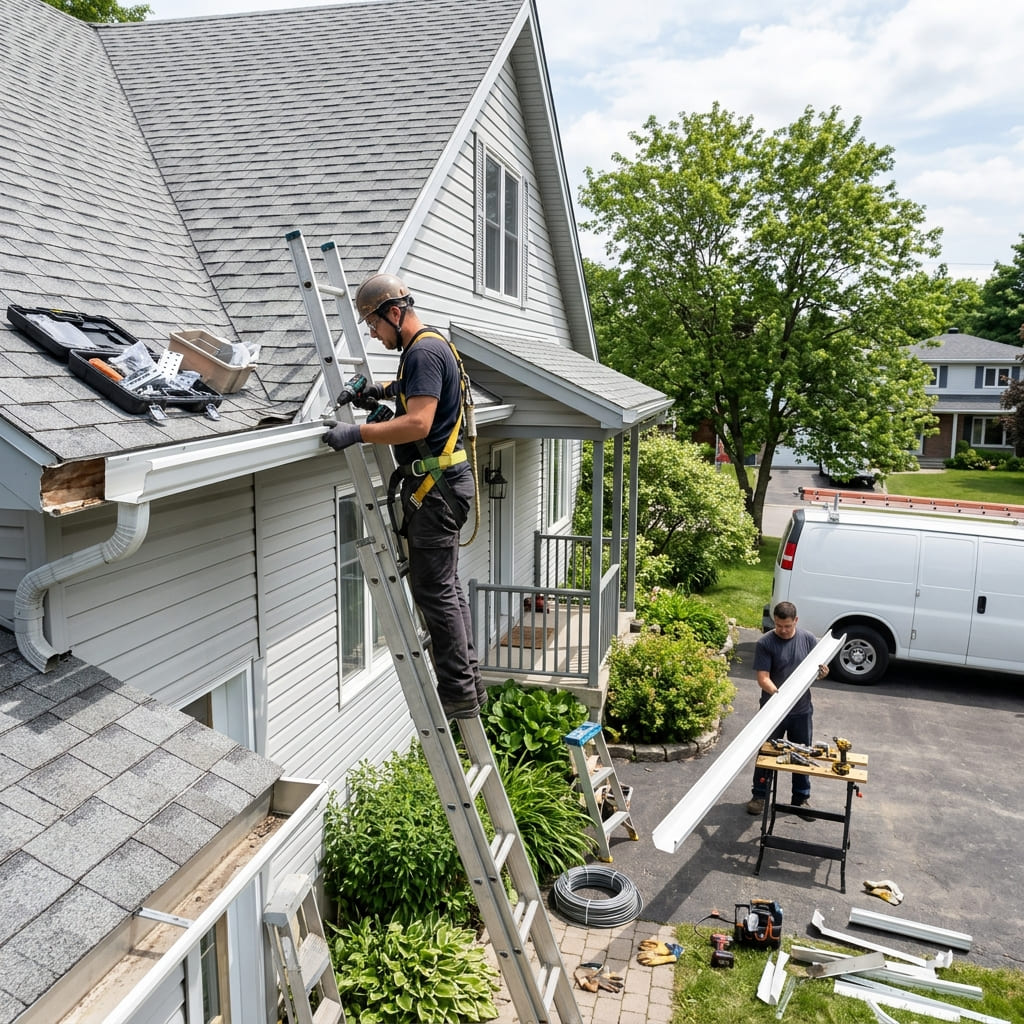
Gutter Installation in Detroit
New gutter on a house that never had it, an addition, or after a re-roof.
Detroit rooflines are steep and narrow-eaved. Sizing 5-inch versus 6-inch trough, and 2x3 versus 3x4 downspout, matters more here than the colour does.
Read the Detroit installation page →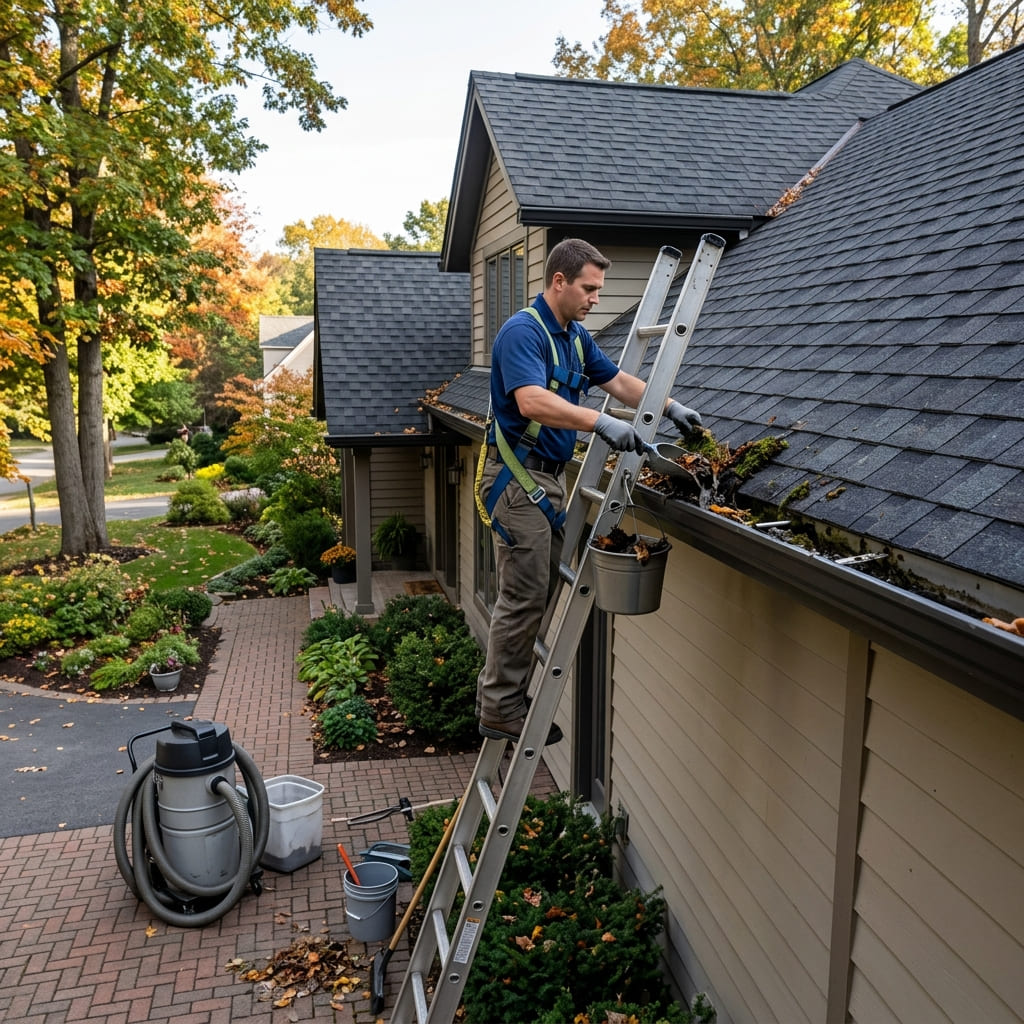
Gutter Cleaning in Detroit
Clearing troughs, miters and downspouts by hand, twice a year.
This is the highest-value maintenance job on a Detroit house. Maple samaras in late May and hardwood leaf in November are the two loads that matter.
Read the Detroit cleaning page →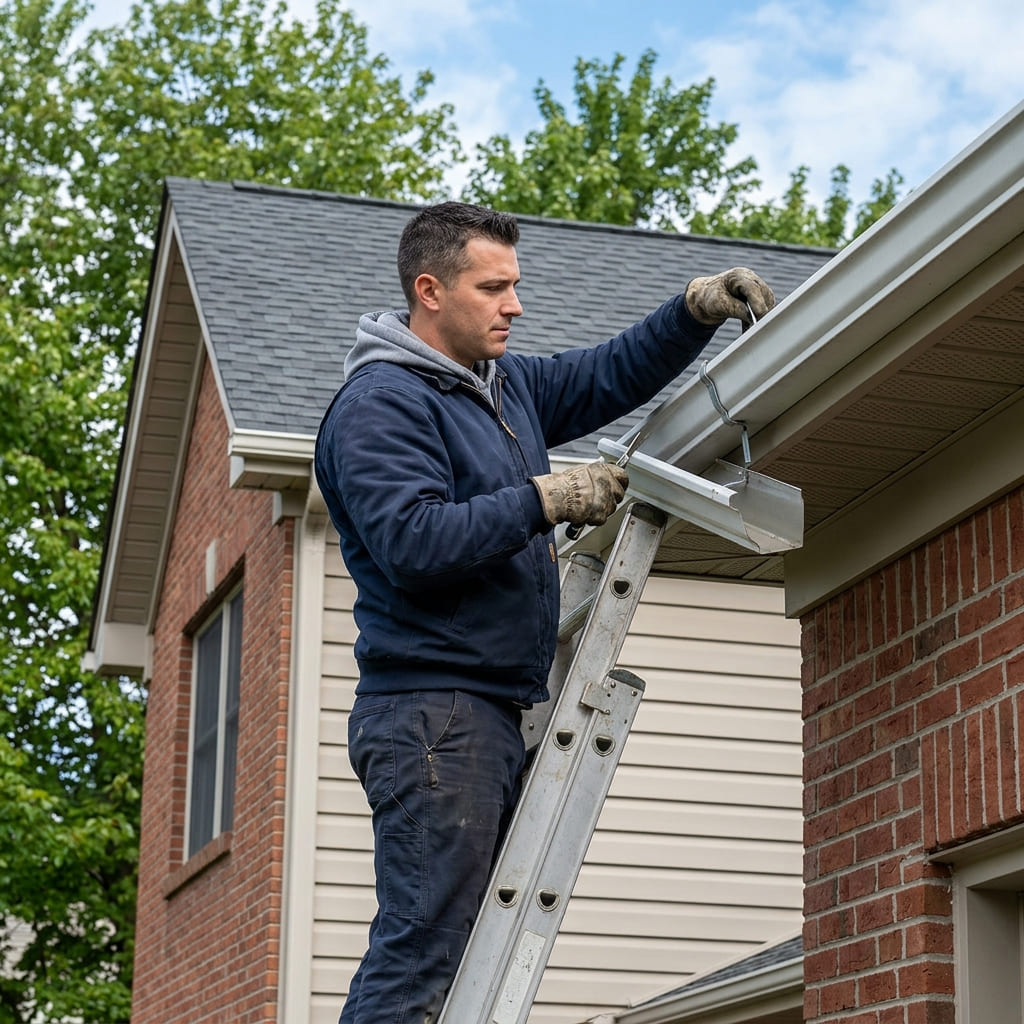
Gutter Repair in Detroit
Sagging runs, split seams, pulled spikes, failed miters, wrong pitch.
Freeze-thaw is the culprit on most Detroit repairs. The question to answer first is whether the fascia behind the gutter is still solid wood.
Read the Detroit repair page →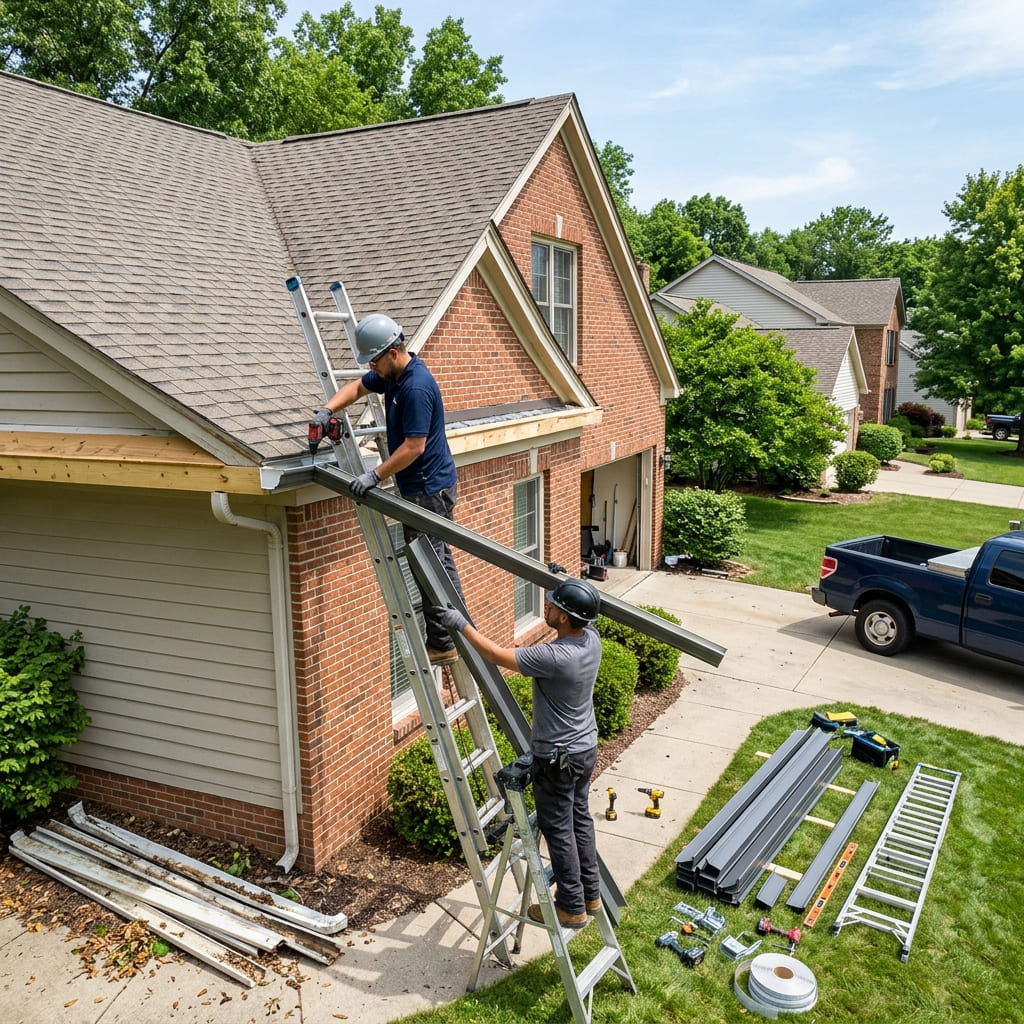
Gutter Replacement in Detroit
Full tear-out and re-hang when repair stops being economical.
On pre-war homes this is often a fascia job with new gutter attached to it, not the other way round. Historic districts add an approval step.
Read the Detroit replacement page →Detroit weather, and what it does to a gutter
Detroit averages roughly 33 inches of rain and about 42 inches of snow in a year. Those are not extreme numbers on their own. What makes them punishing is the pattern.
Spring is about intensity. May and June are the wettest months, and Southeast Michigan gets a genuine convective season — the kind of storm that drops an inch in forty minutes. The city has had two serious reminders in recent memory, with widespread basement flooding in August 2014 and again in late June 2021. Roof water is not the whole story in an event like that, but a downspout dumping at the foundation is not helping.
Winter is about cycling. Southeast Michigan crosses the freezing
point somewhere between 60 and 70 times in an average winter. Every crossing puts
water into a trough, lets it run to the low point, and refreezes it. Ice expands
around 9 percent as it forms, and it does that expansion inside end caps, miters
and hanger holes that were never designed to flex.
That is why Detroit gutters fail in a specific set of ways: split end caps, popped
miters, spikes backing out of soft fascia, downspouts bulging at the elbow, and
whole runs peeling off the fascia in February.
Ice dams, honestly explained
Ice dams are the most misdiagnosed problem in Detroit. They form when heat escapes into the attic, melts snow on the upper roof, and that meltwater runs down and refreezes at the cold overhang where there is no heat underneath it. The ridge of ice grows, water pools behind it, and eventually finds its way under the shingles.
Gutters do not cause ice dams, and new gutters will not stop them. The fix is in the attic — air sealing, insulation depth, and balanced soffit-to-ridge ventilation. Any contractor who quotes you gutters as an ice dam cure is either confused or hoping you are.
What gutters do control is severity. A clean, correctly pitched trough with clear downspouts gives meltwater an exit on a thaw day. A trough packed with November leaves freezes into a block that holds ice against the fascia until March. That is a real difference, and it is the honest case for a fall gutter cleaning in Detroit.
Detroit gutter pricing at a glance
These are typical Detroit-market ranges, not quotes. Every one of them moves with roof height, pitch, linear footage, fascia condition, access and material.
| Job | Typical Detroit range | What moves the number |
|---|---|---|
| Gutter cleaning, single storey | $120 – $200 | Linear footage, tree cover, whether downspouts need clearing |
| Gutter cleaning, two storey | $180 – $300 | Ladder setup, roof pitch, dormers, how long since the last clean |
| Minimum repair service call | $150 – $250 | Covers travel plus a small fix — reseal, re-pitch, one downspout |
| Re-hang existing gutter | $8 – $15 / ft | Whether hangers can bite solid fascia or the board needs replacing |
| Fascia board replacement | $10 – $25 / ft | Rot extent, board size, paint versus wrap, height |
| New 5" seamless aluminum | $8 – $14 / ft installed | Gauge, colour, number of downspouts, corners and miters |
| New 6" seamless aluminum | $11 – $18 / ft installed | Larger trough, 3x4 downspouts, heavier hangers |
| Copper, half-round | $30 – $55+ / ft | Historic district work, soldered joints, material market |
| Built-in box gutter reline | Specialist quote | Cornice condition, liner system, framing repair required |
A typical Detroit brick bungalow carries roughly 110 to 160 feet of gutter, which puts a straight 5-inch aluminum replacement somewhere around $1,300 to $2,600 before fascia work. A two-and-a-half storey four-square in Boston-Edison with copper is a different universe of number.
Neighbourhoods covered in Detroit
Contractors in the GutterSquad Michigan network work across the city and into the enclaves and inner-ring suburbs. A few of the areas where gutter calls come in most often:
- Rosedale Park
- Grandmont
- Boston-Edison
- Indian Village
- Palmer Woods
- Sherwood Forest
- University District
- Green Acres
- East English Village
- Morningside
- Cornerstone Village
- Jefferson-Chalmers
- West Village
- Islandview
- Corktown
- Woodbridge
- Midtown
- New Center
- North End
- Russell Woods
- Bagley
- Springwells Village
- Hubbard Farms
- Warrendale
- Brightmoor
- Chandler Park
Coverage extends past the city line into Hamtramck, Highland Park, Dearborn, Redford, Harper Woods, the Grosse Pointes, River Rouge and Ecorse. Not sure whether your address is covered? Call 123-456-7890 with a cross street.
Choosing a gutter contractor in Detroit
GutterSquad Michigan does not vet, licence, insure or warrant any contractor, so the checks below are on you. They take about ten minutes and they are worth doing on every job above a cleaning.
- Ask for a Michigan licence number and verify it. Michigan requires a residential builder or maintenance and alteration contractor licence for a great deal of exterior residential work. The Department of Licensing and Regulatory Affairs lets you check a licence yourself.
- Ask for a current certificate of insurance — general liability at minimum, and workers' compensation if a crew is on your roof.
- Make them look at the fascia. On a Detroit house this is the question. A quote that prices gutter and never mentions the board it is fastening to is a quote that will change mid-job.
- Ask what hanger they use. Hidden hangers screwed into the fascia hold. Spikes and ferrules are what is already failing on your house.
- Get the downspout count in writing. One downspout per 30 to 40 feet of run is a reasonable baseline. Cutting the count is the quiet way a low bid gets low.
- For a historic district property, ask directly whether they have taken work through the Detroit HDC before. The answer tells you a lot.
Michigan code points worth knowing
Gutters themselves are not generally required by residential code on a Michigan home. What is required is that surface water drains away from the foundation — the Michigan Residential Code calls for grading that falls away from the foundation wall, on the order of six inches of drop within the first ten feet.
That is the whole point of the exercise. A gutter is a tool for getting roof water past that ten-foot zone. A downspout that ends at the wall, or drops into a collapsed buried lead, defeats it entirely — which is why extensions and discharge location matter more than the colour of the trough.
For permit questions specific to your scope, the City of Detroit Buildings, Safety Engineering and Environmental Department is the authority, and the Historic District Commission is the second call if the property is in a designated district.