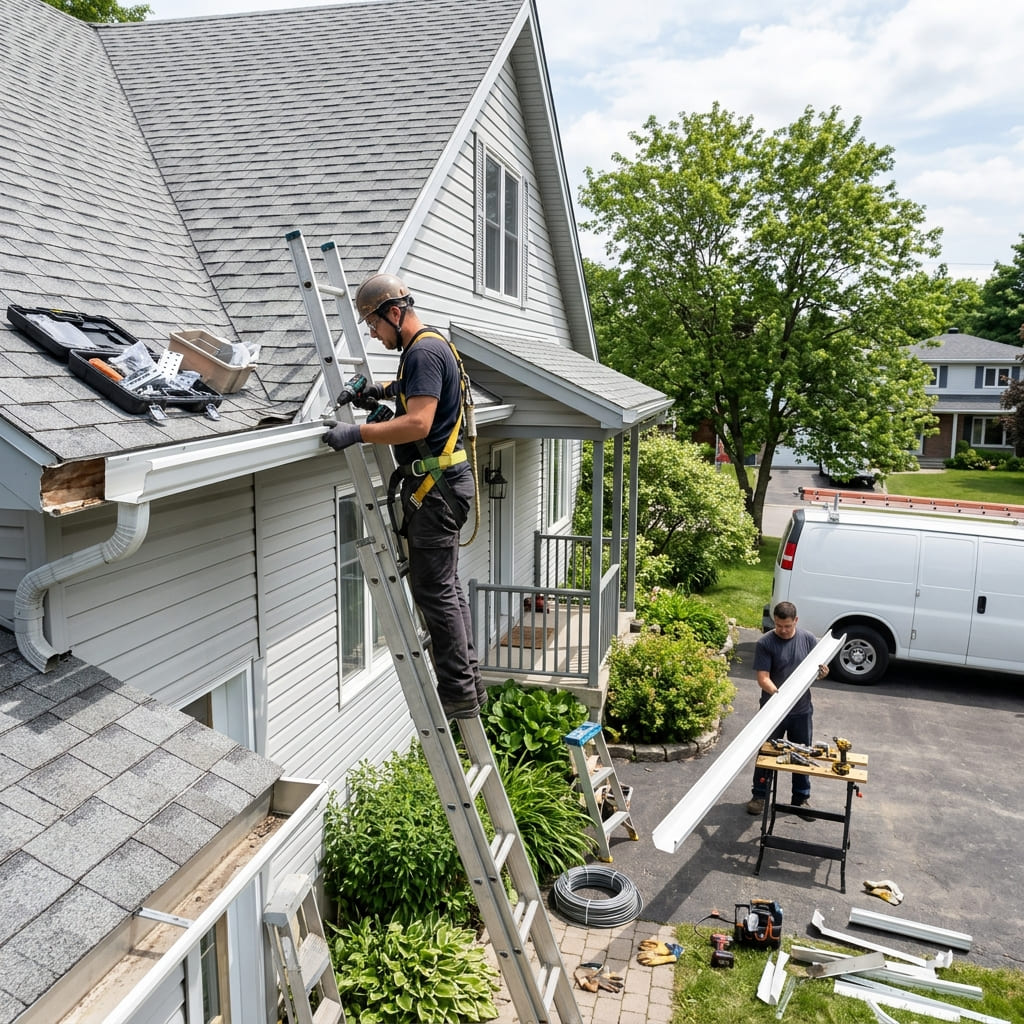
When a Detroit home needs new gutter installed
Installation means putting gutter where there is none, or where the existing system is being redesigned rather than swapped. That is a different job from replacement, and it comes up in Detroit for a few specific reasons.
- A rear elevation or addition that never had gutter — extremely common on Detroit homes where the back porch or an added mudroom was left to drain onto the ground.
- A detached garage, most of which in this city have never had a trough on them, quietly eroding the alley-side slab.
- After a re-roof, when new drip edge and shingle overhang change how water leaves the roof.
- Resizing from 5-inch to 6-inch because the original system was never big enough for the roof above it.
- Converting from built-in box gutter to a hung system, where restoring the cornice liner is no longer economical.
- Rehabilitation work on a house that has been vacant, where the original gutter is long gone.
If gutter is already hanging and the plan is to take it off and put similar back up, read the Detroit gutter replacement page instead — the cost structure and the fascia questions are different.
The Detroit sizing question: 5-inch or 6-inch?
This is the decision that matters most, and it is the one most quotes skip past. Gutter sizing is a drainage calculation driven by three things: the roof area draining into the run, the pitch of that roof, and the peak short-duration rainfall the region actually gets.
Roof pitch is the part people miss. A steep roof does not just deliver water — it delivers it fast, with horizontal momentum. On a steep Detroit bungalow or Tudor plane, water can arrive at the eave moving quickly enough to overshoot a 5-inch trough entirely during a hard summer downpour. The gutter is spotless, the downspout is clear, and it still pours over the front lip.
| Spec | 5-inch K-style + 2x3 downspout | 6-inch K-style + 3x4 downspout |
|---|---|---|
| Relative trough capacity | Baseline | Roughly 40% more |
| Downspout cross-section | 6 sq in | 12 sq in — about double |
| Clog resistance | Maple seed plugs the outlet readily | Passes far more debris before blocking |
| Typical Detroit fit | Ranches, modest bungalows, low-slope runs | Steep pitches, valleys, long runs, heavy tree cover |
| Installed cost | $8 – $14 / ft | $11 – $18 / ft |
| Look on an older Detroit home | Period-typical proportion | Noticeably heavier profile on a narrow eave |
The practical Detroit rule: if the roof is steep, if two planes meet in
a valley that dumps into a short section of trough, or if the house sits under mature
maple, the extra few hundred dollars for 6-inch and 3x4 downspouts buys more than the
same money spent anywhere else on the job.
On a low-slope 1950s ranch on the far east side with a clear roof and a modest footprint,
5-inch is genuinely adequate and there is no need to be upsold.
Materials that make sense on a Detroit house
Seamless aluminum — the default, and usually the right one
Aluminum coil is roll-formed on site into a single continuous run, with joints only at corners and end caps. It does not rust, it carries a baked-on finish in a wide colour range, and it is the most cost-effective option by a distance.
Ask about gauge. Standard residential aluminum is .027 inch. Heavier .032 costs modestly more and resists denting from ladders, ice load and falling branches noticeably better. In a climate that puts ice in the trough sixty times a winter, that upgrade is one of the better-value line items on a Detroit quote.
Galvanized and galvalume steel
Stronger than aluminum and better able to take an ice load or a ladder without deforming. The trade-offs are real: steel is sectional rather than seamless, so it has joints every ten feet, it is heavier on old fascia, and it will eventually corrode at cut edges and fastener penetrations.
A lot of Detroit's post-war housing still has original galvanized gutter hanging on it — which is a testament to the material, and also usually well past the point where it should have been replaced.
Copper and half-round
Copper half-round is the historic-district material. It is soldered rather than sealed, which means the joints are metallurgical rather than dependent on a sealant that ages, and a properly installed copper system can last many decades. It also costs several times what aluminum does — commonly $30 to $55 per foot and up.
On a Tudor in Palmer Woods, a four-square in Boston-Edison or a home in Indian Village, copper or a copper-alternative half-round may not be optional. It may be what the Detroit Historic District Commission expects for a house that had it originally.
Built-in box gutters
On Detroit homes built before roughly 1920 — Woodbridge, Corktown, Brush Park, the older North End streets — the gutter is often framed into the cornice and lined, rather than hung on the fascia. That is a restoration trade rather than a gutter-hanging one.
Relining with a modern membrane or metal liner keeps the original roofline and is usually the historically appropriate answer. Abandoning the box and hanging a K-style run below it is cheaper, changes the look of the house, and in a designated district may not be approvable. Ask for both options priced.
How a seamless gutter installation actually goes
- Measure and assess. Every run measured, roof planes and valleys noted, downspout locations planned around the lot and the grade — not just the corners. Fascia condition checked with a probe, not a glance.
- Fascia and drip edge prepared. Soft board replaced. A gutter apron or drip edge fitted so water leaving the shingle is directed into the trough. Older Detroit homes frequently have no drip edge at all, which is exactly how water ends up running down the back of the gutter and into the fascia.
- Gutter roll-formed on site. A truck-mounted machine forms the coil to the exact length of each run. Inside and outside miters are cut and sealed; end caps are fitted and sealed.
- Hung on hidden hangers with screws. Not spikes. Hangers typically at 24-inch spacing, tightened toward 16 to 18 inches on long runs and anywhere ice load is expected. This is where Michigan installs should differ from a milder climate.
- Pitched to the outlets. A slight, consistent fall — on the order of a quarter inch over ten feet — so nothing stands in the trough. Standing water is what freezes, and what freezes is what splits the seams.
- Downspouts hung and secured, with elbows and straps, and outlets cut cleanly rather than punched.
- Water tested. A hose run through every section, checking for standing water, weeping joints and downspout flow. Then clean-up and haul-away.
Most single-family Detroit installs are a one-day job. Where fascia has to be replaced, or where a historic district approval is in play, plan for longer.
The detail worth insisting on: a gutter apron. It is an inexpensive strip of flashing that carries water off the shingle edge into the trough instead of letting it wick behind. On Detroit's older housing stock, its absence is one of the most common reasons fascia rots out from behind perfectly good-looking gutter.
Gutter installation cost in Detroit
Typical Detroit-market ranges, not quotes. Linear footage sets the base; height, fascia condition and material set everything else.
| Line item | Typical Detroit range | Notes |
|---|---|---|
| 5" seamless aluminum, installed | $8 – $14 / ft | Gauge, colour and corner count move this |
| 6" seamless aluminum, installed | $11 – $18 / ft | Includes larger 3x4 downspouts and heavier hangers |
| Galvanized or galvalume steel | $14 – $22 / ft | Sectional; stronger, heavier, will corrode eventually |
| Copper half-round | $30 – $55+ / ft | Soldered joints; historic district work; material market swings |
| Downspout, per drop | $70 – $180 | Height, elbows, straps and whether it wraps a corner |
| Underground or extended discharge | $150 – $600+ per run | Depends heavily on lot grade and length |
| Fascia replacement | $10 – $25 / ft | Frequently needed on pre-war Detroit homes |
| Gutter apron / drip edge | $2 – $5 / ft | Cheap, and one of the highest-value items on the quote |
| Detached garage run | $300 – $700 | Usually 60 – 90 ft with one or two downspouts |
Worked example. A Detroit brick bungalow with 140 feet of run, four downspouts, 5-inch aluminum, no fascia work: roughly $1,400 to $2,200. The same house stepped up to 6-inch with 3x4 downspouts: roughly $1,900 to $2,900. Add twenty feet of fascia replacement and you are adding another $200 to $500.
Where the water goes matters more than the gutter
A gutter is only a delivery mechanism. The point of the whole exercise is getting roof water past the foundation, and Detroit lots make that harder than most.
Side yards are narrow, grade is close to flat across much of the city, and on pre-war stock the downspout often drops into a buried lead tied into the combined sewer. Those leads are eighty to a hundred years old; when one collapses, roof water surfaces right at the wall with nothing visible above ground to explain it.
The Michigan Residential Code approach to this is grading: surface water should fall
away from the foundation, on the order of six inches within the first ten feet. A new
gutter that discharges at the wall works against that no matter how well it is hung.
Practical answers on a Detroit lot: above-ground extensions carrying water six to ten
feet out, discharge onto lawn rather than into a buried line — which is what Detroit
Water and Sewerage has long encouraged anyway — and downspout placement chosen for
where the grade actually falls, not just where the corners are.
Historic districts and approvals
Detroit has a large number of locally designated historic districts, and exterior changes visible from the public right-of-way generally require review by the Detroit Historic District Commission.
For gutter work, the practical distinction is repair-in-kind versus change. Replacing a
failed copper half-round with new copper half-round is a very different application from
replacing it with white aluminum K-style.
If the house is in Indian Village, Boston-Edison, Palmer Woods, Sherwood Forest, West
Village, Corktown, Woodbridge or another designated district, build the approval step
into your timeline and ask any contractor directly whether they have taken work through
the HDC before. The answer is informative.
What separates a good Detroit install from a bad one
- Hidden hangers with screws, not spikes. Spikes are what is already failing on the house next door.
- Hanger spacing tightened for snow load — 16 to 18 inches on long runs rather than a uniform 24.
- A gutter apron fitted at the shingle edge. Missing on most older Detroit homes and the single cheapest fix for fascia rot.
- Consistent pitch to the outlet, verified with water, not eyeballed.
- Downspout count sized to the runs, roughly one per 30 to 40 feet, with more where valleys concentrate flow.
- Sealed miters and end caps with a sealant rated for the temperature swing this climate delivers.
- Fascia addressed before gutter goes up — not noted on the invoice as a future problem.
- Discharge planned, not left as a stub at the wall.
Neighbourhoods we cover in Detroit
Installation calls come from across the city — new runs on rear elevations in Bagley, Grandmont and Rosedale Park, garage runs through Morningside, Cornerstone Village and East English Village, resizing to 6-inch on steep pitches in Green Acres, Sherwood Forest and the University District, and half-round and copper work in Boston-Edison, Indian Village, Palmer Woods and West Village.
Coverage also runs into Hamtramck, Highland Park, Dearborn, Redford, Harper Woods and the Grosse Pointes. Call 123-456-7890 with a cross street to confirm.
Get a gutter installation estimate in Detroit
Call GutterSquad Michigan at 123-456-7890. Have the neighbourhood, the number of storeys, roughly how much gutter the house needs, and whether the fascia has been looked at recently. That is enough for a Detroit gutter professional to give you a realistic range and book a site visit.
Not sure whether you need a new system or a fix? The Detroit gutter repair page covers what is worth saving, and the Detroit services hub lays out all four jobs side by side.