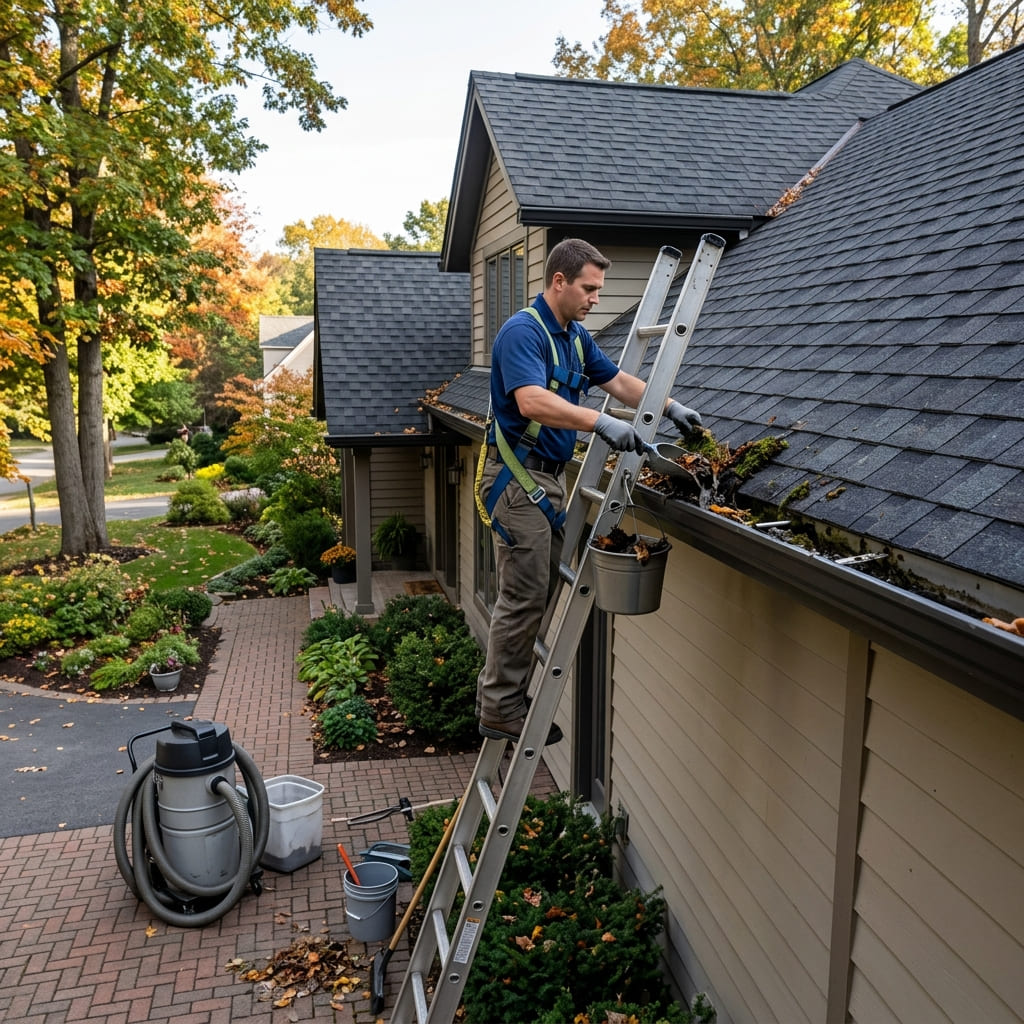
What a proper gutter cleaning in Detroit includes
A gutter cleaning worth paying for is a hand job, not a hose job. Blasting a pressure washer down the run moves the top layer of leaves and pushes the compacted sludge underneath straight into the downspout, where it sets like concrete.
On a Detroit house the work should cover:
- Every trough on the house, including the back and the garage run — not just the elevation the truck is parked on.
- Debris removed and hauled away. Wet maple seed and leaf mat dropped into the beds ends up back in the gutter or in the window wells.
- Every miter and outlet cleared by hand. Corners and the two inches around a downspout hole are where plugs actually form.
- Every downspout flow-tested. A trough can look perfect and still overflow because the elbow at the bottom is packed.
- Troughs flushed after clearing so standing water and low spots show themselves.
- A condition report. Pitch, hanger spacing, seam sealant, end caps, and the state of the fascia behind the run.
That last item is the part most Detroit homeowners underrate. A cleaning puts someone on a ladder at the eave of a house whose fascia may be ninety years old. Ten minutes of looking while they are up there is the cheapest inspection you will ever get, and it is how a $2,400 gutter replacement turns into a $300 repair caught early.
One question to ask before you book: "Do you bag and haul the debris, and do you flow-test the downspouts?" A surprising number of cheap cleaning quotes do neither, and a gutter that drains nowhere is not clean.
The Detroit debris calendar
Cleaning schedules copied from national websites do not fit this city, because Detroit's tree canopy has its own timetable. Silver and Norway maple dominate the street trees, honey locust fills a lot of the commercial corridors, and tree-of-heaven has colonised a great deal of vacant land. Each drops something different, at a different time.
| When | What falls | Why it matters |
|---|---|---|
| April | Maple and elm flower tassels, tree-of-heaven bloom | Fine material that sinks and forms the base layer of a plug |
| Late May – early June | Silver and Norway maple samaras | The heaviest single load of the year. Packs into a dense mat and sprouts in the trough |
| June | Cottonwood fluff | Mats over outlets and traps everything landing on top of it |
| All summer | Asphalt shingle granules | Sinks to the bottom, holds moisture against the seam sealant, accelerates corrosion |
| Late October – mid November | Hardwood leaf drop — Norway maple is among the last | The load that must be gone before the first hard freeze |
| December – March | Ice and refreeze cycles | Anything still in the trough becomes structural load and expands into the seams |
That calendar gives you the two dates that matter: a clean in early June, once
the samaras are down, and a clean in mid-to-late November, once the leaves are.
Booking the fall clean too early is the most common mistake in Detroit. Norway maple
holds its leaves late — often into the second week of November — so a cleaning done in
the third week of October leaves the heaviest load of the season still to come.
Why a clogged gutter costs more in Detroit than in most cities
In a mild climate a blocked gutter is a nuisance. Here it is the start of a chain, and the chain runs through parts of a Detroit house that are expensive to fix.
The fascia problem
Detroit's residential stock is dominated by homes built between roughly 1910 and 1955, most of them with original wood fascia. That board has been painted repeatedly over decades, and paint hides softness remarkably well.
A full trough is heavy. Wet leaf and maple seed hold water, and when that freezes the
load multiplies. All of it hangs off fasteners driven into that board.
When the fastener starts to pull, the run tips outward, which stops it draining, which
keeps it wetter, which softens the board faster. The failure feeds itself. That is why
so many Detroit gutter jobs turn out to be
fascia repair with a gutter attached
rather than a simple re-hang.
The freeze-thaw problem
Southeast Michigan crosses the freezing point somewhere between 60 and 70 times in an average winter. Each crossing melts water into the trough, lets it settle at the low point, and refreezes it. Ice expands roughly 9 percent as it forms, and it does that inside end caps, miters and hanger holes never designed to flex.
Split end caps, popped miters and spikes backing out of soft fascia are the standard Detroit spring damage list, and a gutter that went into December full is where most of it starts.
The foundation problem
A blocked gutter dumps its entire roof load at one point, usually directly against the wall. On a Detroit house that wall is very often a full basement with a stone or early poured foundation, and the lot grade is close to flat.
Detroit has had two hard reminders of what concentrated water does here — the August 2014 event and the late June 2021 flooding, both of which put water into basements across the city. Roof drainage is not the whole story in a storm like that, but a downspout discharging at the foundation is unambiguously making it worse.
The buried lead problem
On much of the pre-war housing stock, the downspout does not end at a splash block at all. It drops into a buried line at the base of the wall that ties into Detroit's largely combined sewer — one pipe carrying both storm and sanitary flow.
Those leads are often eighty to a hundred years old. When one collapses or plugs, roof
water surfaces right at the foundation with no visible cause above ground.
If your downspout disappears into the ground and the soil beside it is permanently
dark, that lead is the first thing to look at. Detroit Water and Sewerage has long
encouraged disconnecting downspouts and directing roof water onto the lawn instead,
which on most Detroit lots is cheaper and better for the basement than restoring a
century-old buried pipe.
Gutter cleaning cost in Detroit — what to expect
These are typical Detroit-market ranges rather than quotes. Price is driven mostly by ladder time, which means height and access matter more than square footage.
| Home type | Typical Detroit range | Notes |
|---|---|---|
| Single-storey bungalow or ranch (110–160 ft) | $120 – $200 | The most common Detroit job. Straightforward ladder work |
| Storey-and-a-half bungalow with dormers | $150 – $240 | Dormer runs add setups and slow the job |
| Two-storey colonial or four-square (180–240 ft) | $180 – $300 | Height drives the cost more than footage does |
| Two-and-a-half storey, steep pitch, historic stock | $275 – $450 | Boston-Edison, Indian Village and similar. Extended ladders, careful access |
| Two-family flat with rear runs and garage | $180 – $320 | Detroit flats often have more linear footage than they look like they do |
| Downspout unblocking (per downspout, beyond a routine clear) | $40 – $95 | For a genuine plug needing disassembly, not a normal flush |
| Neglected 3+ years, packed and sprouting | Add 25 – 60% | Compacted mat has to be dug out, and the run needs a real inspection after |
Two things that quietly raise a Detroit quote: a detached garage with its own run down the alley, and a rear elevation the ladder cannot reach from level ground. Mention both when you call and the number you get on the phone will be closer to the number on the invoice.
Signs your Detroit gutters need clearing now
- Water sheeting over the front edge in a normal rain. Not a storm — a normal rain. That is a plug, not a capacity problem.
- Seedlings growing in the trough. Maple sprouts mean a seed mat that has been holding moisture for weeks.
- Staining or streaking down the fascia and siding. Water is going over the back edge of the trough, which means it is sitting full.
- A downspout that stays silent in heavy rain while the one at the other corner runs hard.
- Sagging in the middle of a run. Weight from packed debris, usually with a hanger already let go.
- Erosion trenches or permanently dark soil at one point along the foundation.
- Icicle curtains along one section in winter while the rest of the eave is clear — that section is holding water.
- Mosquitoes near the eaves in July. Standing water in a trough is a breeding site.
DIY or hire it out on a Detroit house?
On a single-storey ranch with an accessible perimeter and a stable ladder, cleaning your own gutters is reasonable work. Plenty of Detroit homeowners do it and do it well.
The calculation changes on the city's older stock. A storey-and-a-half bungalow puts the
dormer run at an awkward height, a Boston-Edison four-square puts the eave near thirty
feet, and many Detroit lots have narrow side yards where there is no level ground to
foot a ladder on.
Ladder falls are the leading cause of serious home-maintenance injuries, and a wet
November roof edge is exactly the condition they happen in. If the eave is above single
storey, or the ground is not level, hire it out.
If you do the work yourself: use a stand-off so the ladder does not rest on the gutter, clear by hand into a bucket rather than flinging debris, flush every downspout when you are done, and take five minutes to press on the fascia while you are up there.
Gutter guards in Detroit — the honest version
Guards get sold hard in this market, so it is worth being plain: a guard reduces cleaning frequency. It does not eliminate cleaning.
Fine debris is the reason. Shingle granules, maple samara wings, cottonwood fluff and honey locust leaflets either pass through a mesh or build a mat on top of it. Reverse-curve guards can overshoot in a hard Detroit summer downpour. Foam inserts hold moisture and become a seed bed.
Where guards genuinely earn their money in Detroit is on a house under heavy maple where the alternative is three cleans a year, or on a two-and-a-half storey where every visit is an expensive ladder setup. On a modest bungalow with light debris load, the payback period is long. Either way, the downspouts still need checking, and the guard surface itself needs clearing.
Neighbourhoods we cover in Detroit
Cleaning calls come in from across the city. Contractors in the GutterSquad Michigan network cover the west side through Rosedale Park, Grandmont, Bagley and Warrendale, the historic districts of Boston-Edison, Sherwood Forest, Palmer Woods and the University District, the near-central neighbourhoods of Woodbridge, Corktown, Midtown and the North End, and the east side through Morningside, East English Village, Cornerstone Village, West Village and Jefferson-Chalmers.
Coverage extends into Hamtramck, Highland Park, Dearborn, Redford, Harper Woods and the Grosse Pointes. Call 123-456-7890 with a cross street and we will confirm on the spot.
Get gutter cleaning pricing for your Detroit home
Call GutterSquad Michigan at 123-456-7890. Tell us the neighbourhood, whether the house is one storey or two, roughly how much gutter is on it, and when it was last cleaned. That is enough for a local gutter professional to give you a realistic number.
If it turns out the trough is holding water after clearing, or the fascia has gone soft, the honest next step is a Detroit gutter repair or, past a certain point, a full replacement. The Detroit services hub lays out how to tell the difference.