When a Detroit gutter system is genuinely done
Age alone is not the test. Plenty of twenty-five-year-old aluminum on Detroit houses is still straight, sound and worth keeping. What matters is how many things are failing and whether the board behind it can still hold a screw.
Replacement is the right call when several of these are true at once:
- Sagging on more than one elevation. One run is a repair. Three is a system.
- Seams already caulked more than once. A joint that has been resealed twice is worn out, not leaking.
- Standing water in the trough after a clean. The pitch is gone and the hangers cannot hold it.
- Visible corrosion, splits or creasing. Common on original galvanized from the 1950s and 60s, still hanging on a lot of Detroit houses.
- Overflow when the gutter is clean. That is a capacity problem, and no repair fixes an undersized trough.
- Soft fascia along a meaningful length. Nothing you fasten to it will hold.
- A repair quote approaching half the cost of replacing the elevation. At that point the maths has already decided.
If only one or two of those apply, read the Detroit gutter repair page first. Repair is very often the better value on a house in this city, and a good contractor will say so.
What a Detroit gutter replacement actually involves
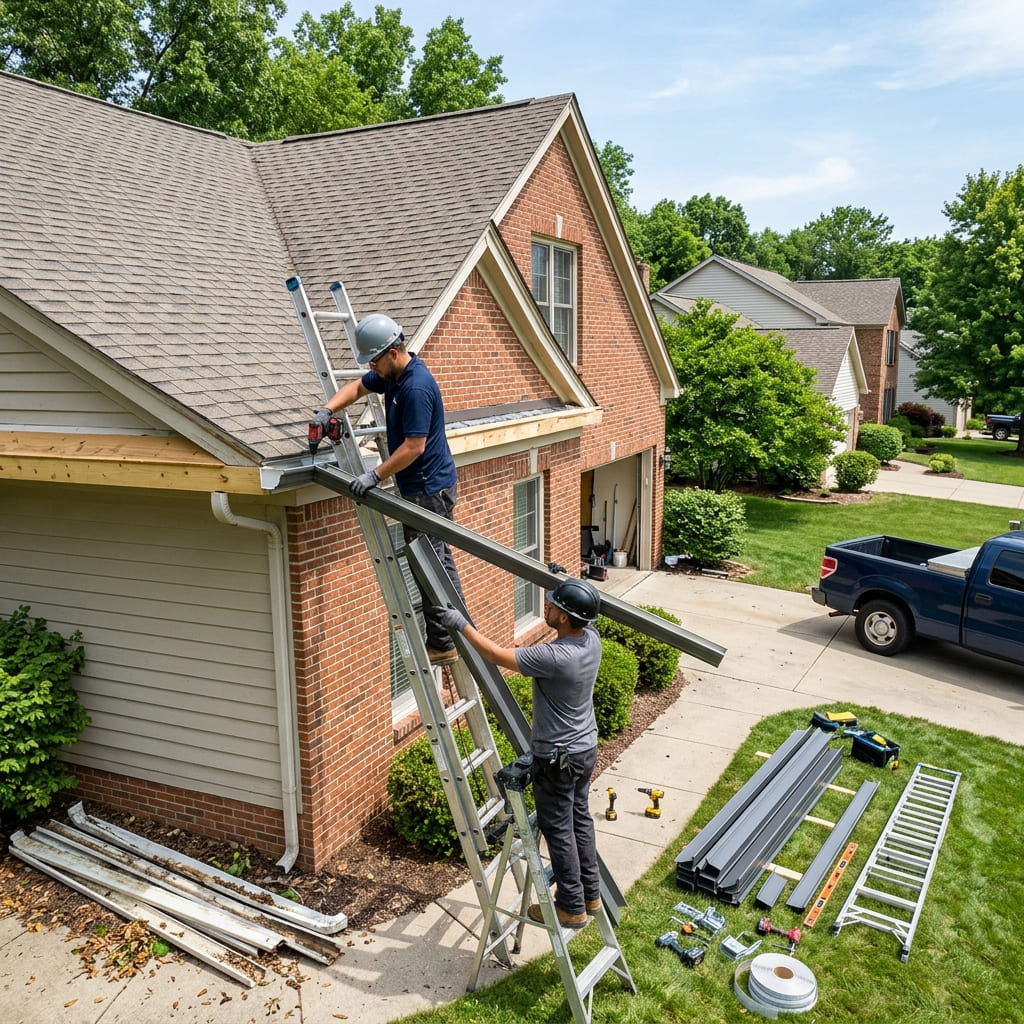
- Tear-out and disposal. Old gutter, downspouts, spikes, ferrules and brackets come off and leave the property. On older Detroit homes this frequently exposes two or three layers of previous fasteners in the same board.
- Fascia inspection — the important part. This is the one moment the board is fully visible in its entirety. Every foot of it gets checked, particularly behind old downspout outlets and at the ends of runs where water has been sitting.
- Fascia repair or replacement where the board is soft. Doing this after new gutter is hung means paying to take that gutter down again, so it happens now or it does not happen.
- Gutter apron or drip edge fitted. A great many pre-war Detroit homes have none at all. Without it, water wicks off the shingle edge and runs down the back of the trough into the fascia you just paid to replace.
- New gutter roll-formed on site. Seamless aluminum is formed to the exact length of each run from a truck-mounted machine, so joints exist only at corners and end caps.
- Hung on hidden hangers, screwed into solid wood. Spacing typically 24 inches, tightened to 16 to 18 on long runs and where ice load is expected. This is the single biggest difference between a Michigan-appropriate install and a generic one.
- Pitched, sealed and downspouts hung. A consistent fall to the outlets — roughly a quarter inch over ten feet — miters and end caps sealed, downspouts strapped, discharge planned.
- Water tested and cleaned up. A hose through every run to find standing water and weeping joints before the truck leaves.
Most Detroit single-family replacements are a one-day job. Add a day where fascia has to come off, and add lead time where a historic district approval is required.
Get the fascia language into the contract before work starts. The most common mid-job dispute on Detroit gutter replacements is fascia discovered at tear-out. Ask for a per-foot rate for fascia replacement written into the quote up front, so there is a number already agreed if the board turns out to be soft.
Gutter replacement cost in Detroit
Typical Detroit-market ranges rather than quotes. Tear-out and disposal are included in the per-foot figures below; fascia is not.
| House type | Approx. gutter | 5" aluminum | 6" aluminum |
|---|---|---|---|
| Single-storey ranch | 110 – 140 ft | $1,200 – $2,100 | $1,600 – $2,700 |
| Brick bungalow with dormer | 120 – 160 ft | $1,300 – $2,600 | $1,900 – $3,200 |
| Two-family flat | 150 – 200 ft | $1,700 – $3,200 | $2,300 – $4,000 |
| Two-storey colonial | 180 – 240 ft | $2,000 – $3,800 | $2,700 – $4,700 |
| Four-square / 2.5 storey, steep pitch | 200 – 280 ft | $2,600 – $4,800 | $3,400 – $6,000 |
| Detached garage (add-on) | 60 – 90 ft | $300 – $700 | $450 – $950 |
| Add-on | Typical Detroit range | Worth it? |
|---|---|---|
| Fascia board replacement | $10 – $25 / ft | Not optional if the board is soft |
| Gutter apron / drip edge | $2 – $5 / ft | Yes — the best-value item on the quote |
| Upgrade .027 → .032 aluminum | +10 – 20% on material | Yes, in a climate with sixty freeze cycles |
| Extra downspout | $70 – $180 each | Yes, if runs exceed 30 – 40 ft between drops |
| Extended discharge / buried-lead disconnection | $120 – $600 | Yes on flat Detroit lots and narrow side yards |
| Aluminum fascia capping | $6 – $12 / ft | Only over sound wood — never over rot |
| Copper half-round | $30 – $55+ / ft | Historic district work; a different bracket entirely |
Upgrades worth taking while the gutter is off
Replacement is the cheap moment for three things that are expensive to retrofit later.
1. The gutter apron. Two to five dollars a foot, and it is what stops water running behind the trough into the fascia. On Detroit's older housing stock its absence is one of the most common causes of rot behind gutter that looks fine from the street.
2. Heavier aluminum. Standard residential coil is .027 inch. Moving to .032 costs modestly more and resists denting from ladders, ice load and falling limbs noticeably better. In a climate that freezes the trough dozens of times a winter, that is a sensible place to spend.
3. An honest look at sizing. If the existing gutter overflowed when it was clean, it was too small. Six-inch trough holds roughly 40 percent more than five, and a 3x4 downspout moves close to double what a 2x3 does. On steep bungalow and Tudor pitches, on long unbroken runs, and where a valley dumps into one short section, that upgrade is the difference between a system that works and one you will be back to in three years. The Detroit installation page works through the sizing decision in detail.
Built-in box gutters and historic districts
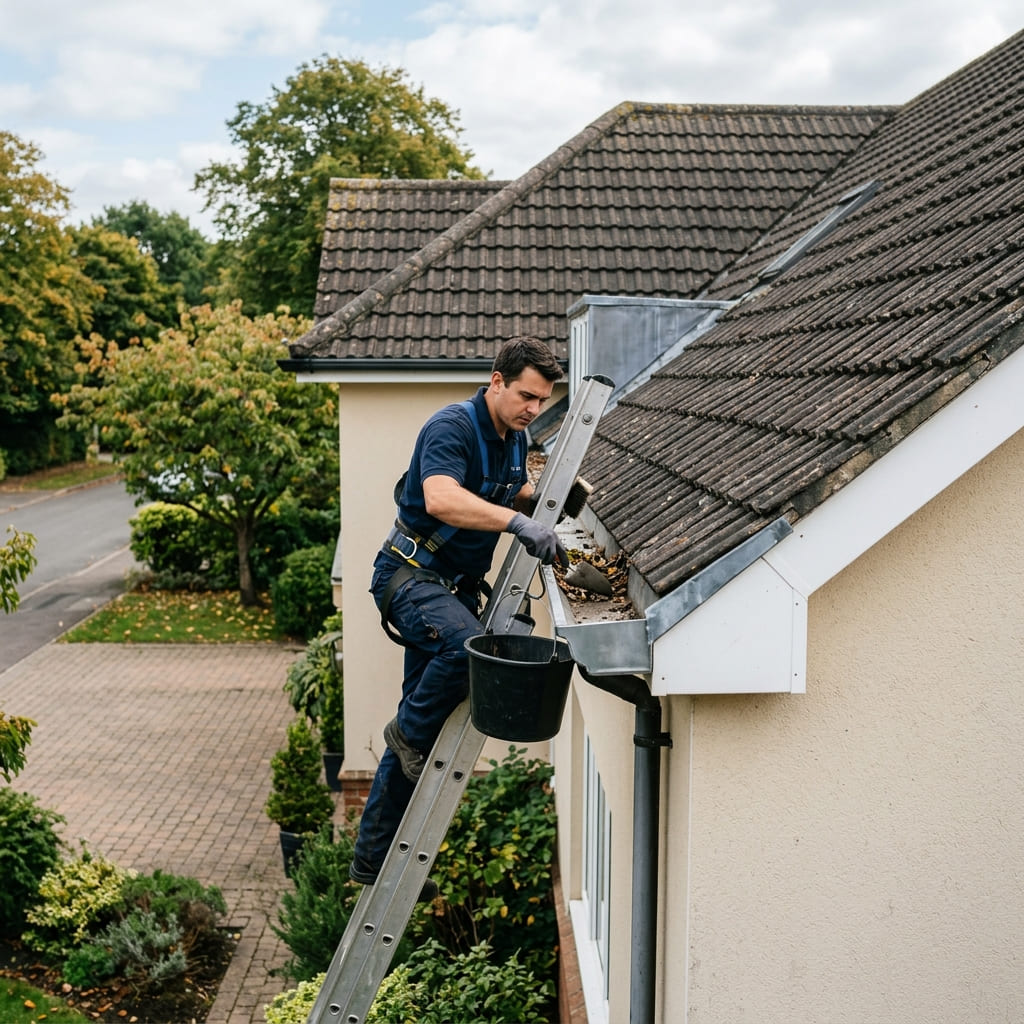
On Detroit homes built before about 1920, the gutter is frequently framed into the cornice itself and lined with metal or membrane, rather than hung off the fascia. You see it through Woodbridge, Corktown, Brush Park and the older streets of the North End.
When the liner fails, water enters the cornice and the wall instead of running down the
outside of the house. That makes it a structural problem rather than a nuisance, and it
makes the replacement decision consequential.
Relining keeps the original roofline and is usually the historically
appropriate answer. Abandoning the box and hanging a K-style run beneath
it is cheaper, changes the look of the house, and in a designated historic district may
not be approvable. Get both options priced and ask which the contractor has actually done
before.
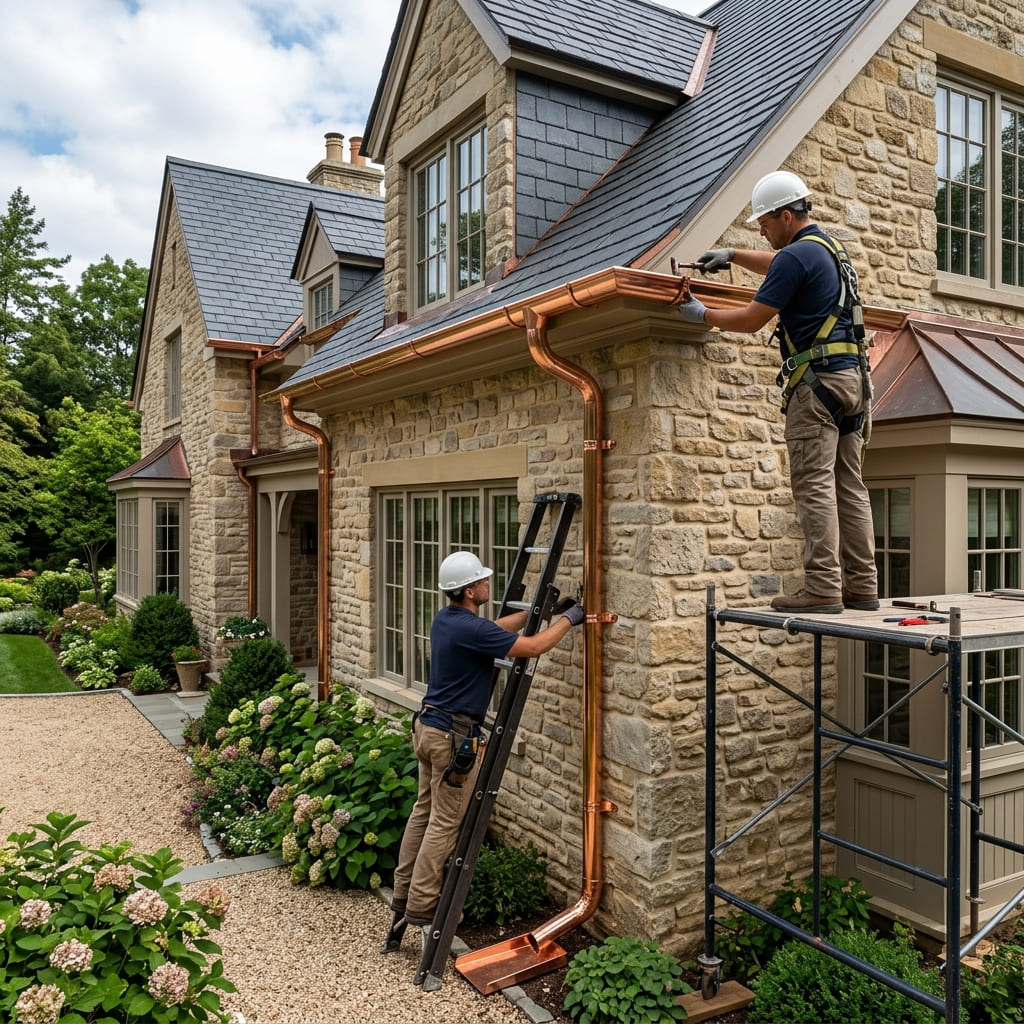
Detroit has a substantial number of locally designated historic districts — Indian Village, Boston-Edison, Palmer Woods, Sherwood Forest, West Village, Corktown, Woodbridge and others. Exterior changes visible from the public right-of-way generally require review by the Detroit Historic District Commission.
In practice: replacing copper half-round with new copper half-round is a very different application from replacing it with white aluminum K-style. Build the approval step into the timeline, and ask any contractor directly whether they have taken work through the HDC before.
Timing a replacement in Detroit
Late spring through early autumn is the easy window. Sealant cures properly, fascia is dry, and lead times are shorter than in the September-to-freeze rush when everyone in Metro Detroit is trying to get ahead of winter.
Aluminum can be formed and hung in cold weather and it is done here every winter, but two
things get harder: sealant at miters and end caps needs temperature to cure, and fascia
work on frozen or wet board is genuinely worse work.
If a run has come down and water is hitting the foundation, do not wait for May. If it is
a planned job, book it for the spring and you will get a better price and a contractor
who is not racing weather.
After replacement: what still needs doing
New gutter resets the clock. It does not remove the maintenance, and in Detroit the maintenance is what determines whether you get twenty years or thirty.
- Clear it twice a year — early June after maple seed drop, mid-to-late November after the last leaves. See Detroit gutter cleaning for the local debris calendar.
- Check discharge every spring. Extensions get moved by lawnmowers and snow, and a downspout dumping at the wall undoes the whole system.
- Look after a hard freeze-thaw stretch. Ice damage shows up as a low spot or a weeping miter long before it shows up as a flood.
- Keep the fascia painted or capped. The board is still the part that decides how long the system lasts.
Neighbourhoods we cover in Detroit
Replacement work runs across the city — full re-hangs through Rosedale Park, Grandmont, Bagley and Warrendale, fascia-and-gutter jobs in Morningside, East English Village, Cornerstone Village and Chandler Park, box gutter and copper work in Woodbridge, Corktown, Brush Park, Boston-Edison, Indian Village and Palmer Woods, and two-family flat work through Springwells Village, Hubbard Farms and the North End.
Coverage extends into Hamtramck, Highland Park, Dearborn, Redford, Harper Woods and the Grosse Pointes. Call 123-456-7890 with a cross street to confirm.
Get a gutter replacement estimate in Detroit
Call GutterSquad Michigan at 123-456-7890. Have the neighbourhood, the number of storeys, roughly how much gutter is on the house, how old the current system is, and whether anyone has looked at the fascia. A local Detroit gutter professional can give you a realistic range from that and book a site visit for a firm number.
Still weighing it up? The repair page has the repair-versus-replace table, the installation page covers sizing and materials, and the Detroit gutter services hub puts all four jobs side by side.